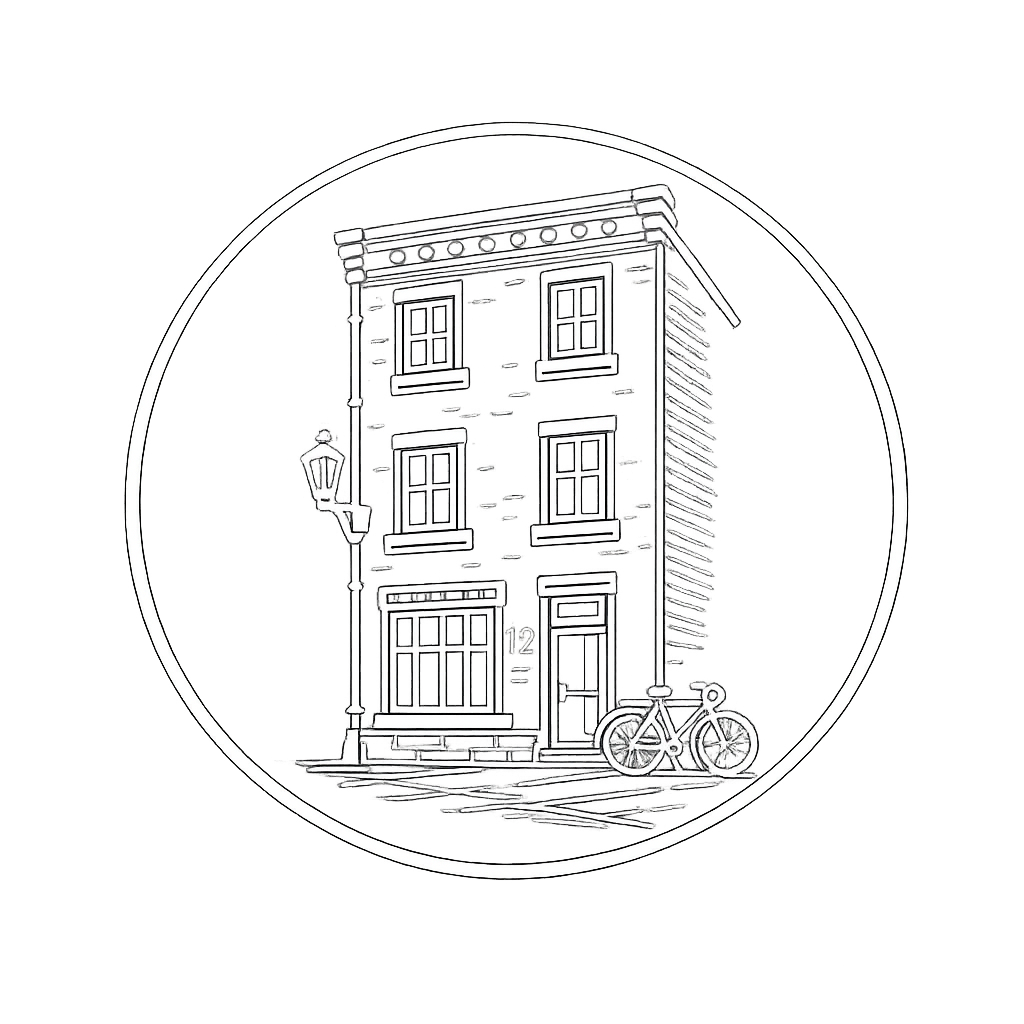
A home, a legacy, a city
When you stay at 12, rue Hébert, you sleep in a building designed in 1856 by Charles-Ferdinand Baillairgé — the last member of the greatest architectural dynasty in Quebec's history. The building holds exceptional provincial heritage status. The Terrasse Dufferin, whose kiosks and lampposts he also designed, is a three-minute walk away.
The building
12, rue Hébert is part of an ensemble of row houses built in the mid-1850s as rental residences in the Colline parlementaire neighbourhood. It forms a coherent whole with 14, rue Hébert (the Maison Joseph-Morrin, also known as Maison Audet), constructed the same year by the same architect.
The building is constructed in brick and stone in the restrained aesthetic of the Neoclassical style with British influence then fashionable in Quebec between 1790 and 1880, inspired by the London townhouse. Ornamentation is deliberately limited: brick lintels replace stone at door and window openings, giving the building its quietly elegant character.
A square storey was added to No. 12 at a later date, slightly altering the original uniformity of the ensemble — a visible trace of 170 years of continuous habitation.
Heritage record
- Address
- 12, rue Hébert, Québec City
- Borough
- La Cité-Limoilou
- Neighbourhood
- Vieux-Québec — Cap-Blanc — Colline parlementaire
- Year built
- 1856
- Architect
- Charles-Ferdinand Baillairgé
- Materials
- Brick and stone
- Style
- Neoclassical, British influence — London townhouse
- Heritage value
- Exceptional
- Status
- Provincial heritage building · Heritage district (CUCQ)
- Assessment
- February 10, 2025
Sources: Ville de Québec — record 4022 & record 4021
The architect: Charles-Ferdinand Baillairgé (1826–1906)
Born on September 29, 1826 in Quebec City, Charles-Philippe-Ferdinand Baillairgé was the final chapter in an architectural lineage unmatched in North America. Trained under his uncle Thomas Baillairgé, he combined the skills of architecture, civil engineering and surveying — a rare versatility for his era.
A man of both conviction and technical mastery, Baillairgé left a deep imprint on Quebec City's face. He was elected a Fellow of the Royal Society of Canada, the country's highest intellectual distinction. By his death on May 10, 1906, he had shaped some of the city's most iconic landmarks — including two you can see from your apartment door or reach in minutes on foot.
An avenue and a public staircase in Quebec City bear his name today. The pavilion he drew for the Plains of Abraham prison now houses the Charles-Baillairgé Pavilion of the Musée national des beaux-arts du Québec — fifteen minutes on foot from your door.
Key dates
- 1826 Born in Quebec City (September 29)
- ~1840 Training under uncle Thomas Baillairgé
- 1852 Terrasse Dufferin kiosks & lampposts
- 1856 Construction of 12–14, rue Hébert
- 1861 Plains of Abraham Prison (future MNBAQ pavilion)
- ~1875 Université Laval main building
- s.d. Elected Fellow, Royal Society of Canada
- 1906 Died in Quebec City (May 10)
- 2024 His name lives on at the MNBAQ Baillairgé Pavilion
The Baillairgé dynasty — four generations, one city
Few families have shaped a city the way the Baillairgés shaped Quebec City. For nearly a century and a half, four generations passed down the pencil and compass, sculpting the visual identity of the provincial capital.
Jean Baillairgé
1726 – 1805
Founder of the lineage. Sculptor and architect, he laid the foundations of Quebec's Classical style.
François Baillairgé
1759 – 1830
Trained in Paris at the École royale des beaux-arts. Sculpted the interiors of the Notre-Dame de Québec Basilica-Cathedral.
Thomas Baillairgé
1791 – 1859
Prolific architect and mentor to Charles. Designed Notre-Dame-des-Victoires church and many Quebec churches.
Charles-Ferdinand Baillairgé
1826 – 1906
Architect of your apartment. Terrasse Dufferin, Plains of Abraham Prison (MNBAQ), Université Laval. Fellow, Royal Society of Canada.
His works, steps from your door
You are staying in a building signed by Baillairgé. Around you, his other works still define Quebec City's skyline.
Terrasse Dufferin
The ornamental cast-iron kiosks and lampposts that line Quebec City's most famous promenade are Baillairgé's work. Every evening, as you walk above the St. Lawrence, you are walking through his design.
Charles-Baillairgé Pavilion — MNBAQ
The Plains of Abraham Prison he designed in 1861 is now the most iconic pavilion of the Musée national des beaux-arts du Québec — and proudly bears his name.
Université Laval — main building
The central building of the historic campus of North America's first French-language university was designed by Baillairgé in the second half of the 19th century.
Staying at 12, rue Hébert is more than renting an apartment in the heart of UNESCO-listed Old Quebec. It is inhabiting, for the length of your stay, a living page of Quebec's architectural history — designed by a man whose works still define the city you will explore each morning as you step out through that very same door.
Book Le 12 Hébert